
Savannah, Hilton Head, Bluffton, Beaufort
Mold Removal and Water Damage Help in Savannah and the Lowcountry
A musty smell under the house, a stain spreading across the ceiling, water on the floor after a storm. Learn what it most likely is, then talk it through with a local mold and water damage specialist.
- Talk it through with a local mold and water damage specialist
- Crawl spaces, slab homes and raised cottages
- The water source gets fixed first
- Testing only when it answers a real question
Mold, water and storm help
Services
Signs of a job done right
Why us
- Moisture is named. Every write-up should say where the water came from. If it does not, the mold will be back.
- Readings, not guesses. Dry means a meter says dry, not that a wall feels dry to the hand.
- Contained work. Plastic barriers and filtered air keep spores and dust in the work area and out of the rest of the house.
- Photos at each step. Before, during and after. Insurers ask for them, and so will a future buyer.
Savannah, Hilton Head, Bluffton and Beaufort
Service area
Mold and water damage help on both sides of the Savannah River: Chatham County in Georgia and Beaufort and Jasper Counties in South Carolina.
Humidity does half the work here
Coastal Georgia and the South Carolina Lowcountry hold moisture most of the year. Summer air stays thick for months, afternoon storms drop inches of rain in an hour, and tides push water onto low roads and yards. Mold needs only damp material and a few days, so a slow AC drain leak, a torn vapor barrier under a raised house or a roof opening after a storm can turn into growth faster than people expect. That is why the moisture source comes before any cleanup, and why water damage restoration and mold removal are handled as one problem, not two.
Start with what you are seeing
- A musty smell and nothing visible: mold inspection and testing finds hidden damp with meters before anyone talks about lab samples.
- Growth on walls, ceilings, closets or furniture: mold removal and remediation walks through containment, what comes out and how the work is checked.
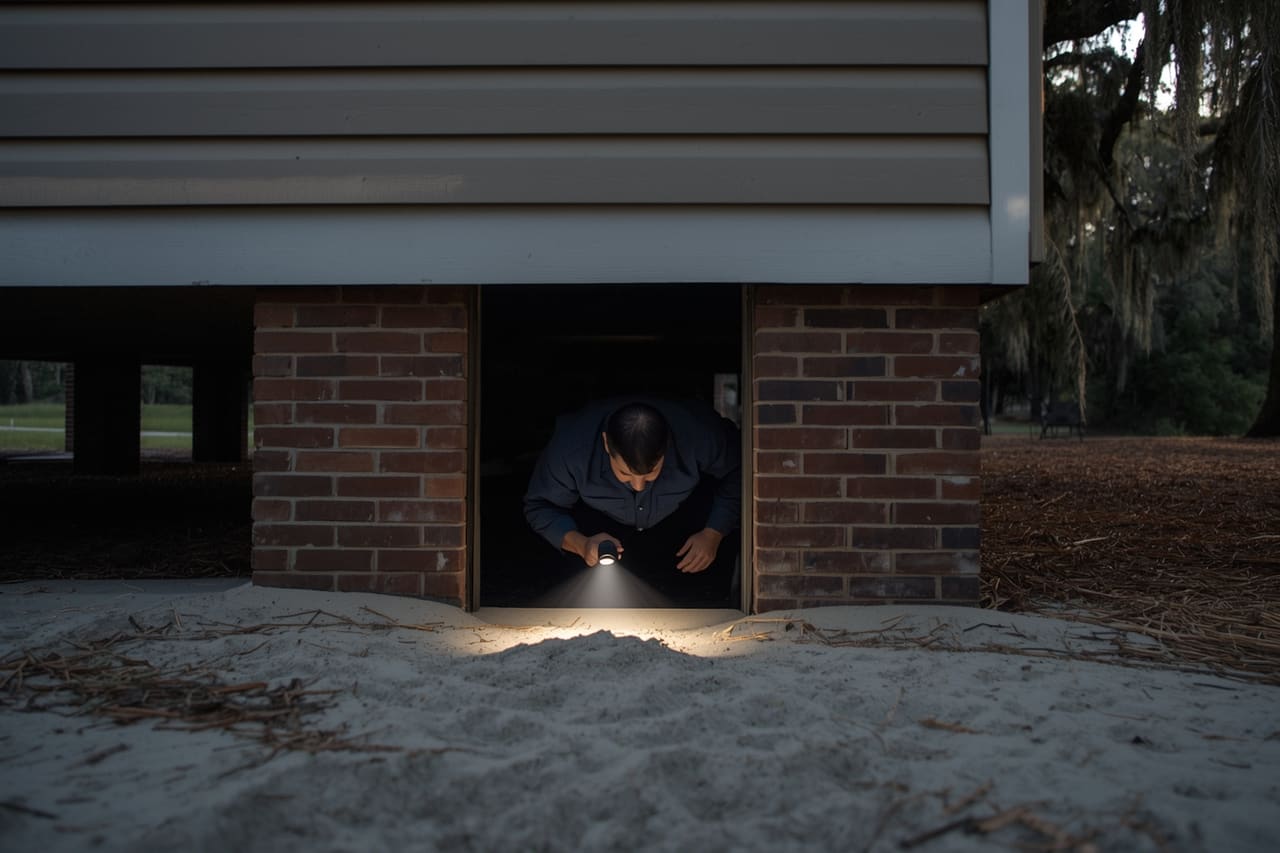
- Damp floors, sagging insulation or sweating ducts under a raised home: crawl space mold removal and the guide to crawl space mold in Lowcountry homes.
- Water on the floor right now: water damage restoration, or burst pipes and leaks if a line, water heater or AC drain let go.
- Tidal or rain flooding: flood damage restoration. Roof or wind damage after a storm: storm and hurricane damage.
- A toilet or drain backup: sewage backup cleanup, since contaminated water changes the rules.
Testing: useful sometimes, not always
When mold is visible, a lab report rarely changes the plan, and the EPA says sampling is usually unnecessary in that case. Testing earns its fee when you smell mold but cannot find it, when a sale, lease dispute or claim needs documentation, and as a clearance check after a larger job. Small patches on hard surfaces, under about ten square feet, are often a homeowner job with detergent, gloves and a respirator. Anything in drywall, insulation or a crawl space, or anything bigger, is worth a professional.
Georgia and South Carolina rules
Neither state licenses mold inspectors or mold remediation companies today. South Carolina lawmakers introduced a certification bill in 2026, but it is not law. So the useful questions are practical ones: what training the crew can show, a written scope and contract, proof of liability insurance, and, for repair work, the contractor's state license number.
Historic homes, island rentals and new subdivisions
Downtown Savannah and Beaufort's old neighborhoods have brick, plaster and heart pine that need slow, careful drying; see mold in historic Savannah homes. Second homes and rentals on Hilton Head, Tybee and around Bluffton often sit closed with the air set high, which invites mold; see closed-up homes and rentals. Newer slab homes in Pooler, Bluffton and Hardeeville have their own weak spots: attic air handlers, drain pans and supply lines.
Where the help covers
Savannah and the rest of Chatham County in Georgia, and Beaufort and Jasper Counties across the river in South Carolina. Town notes are on the service areas page, including Pooler, Tybee Island, Bluffton, Hilton Head Island, Beaufort and Port Royal.
What happens when you call
How it works
Call and say what you see
Where it is, how long it has been there, whether water is still coming in, and whether you own, rent or are about to buy.
Stop the water first
A leak, a drain pan, a crawl space vapor problem or a roof opening. Nothing else holds until the source is handled.
Measure before deciding
Moisture meter and humidity readings show how far the water went. Lab samples come in only when they answer a real question.
Scope and price in writing
What gets dried, what comes out, how the area is sealed off and what it costs, before work begins.
Dry, clean, verify
Equipment runs until the readings say dry. On larger mold jobs, a clearance check by someone other than the crew that did the work.
Frequently asked questions
FAQ
Should I pay for a mold test?
Usually not if you can already see mold. The EPA says sampling is often unnecessary when growth is visible, and there are no federal health-based limits for mold in homes, so a lab number has nothing official to be compared with. Testing earns its cost when you smell mold and cannot find it, when you need a record for a sale or a dispute, or when you want a check after a large removal. See mold inspection.
Can I clean mold myself?
A patch of about 10 square feet or less on a hard surface is often a homeowner job, using detergent and water, gloves, eye protection and an N95 respirator. Mold in drywall, insulation, carpet or a crawl space, a larger area, or mold that keeps coming back needs more than scrubbing. If anyone in the house has asthma or a weak immune system, ask a doctor first. See mold removal.
Do Georgia or South Carolina license mold inspectors or removal companies?
No, neither state does today. Ask for industry training credentials you can verify, a written scope and contract, and proof of liability insurance. South Carolina bill H.5109, introduced in February 2026, would create certification for assessors and remediators and bar an assessor from removing mold in a structure they assessed in the prior 12 months, but it is in committee and is not law. For repair and rebuild work, ask for the contractor's state license number (the Georgia State Licensing Board for Residential and General Contractors, or South Carolina LLR contractor licensing).
Is black mold more dangerous than other colors?
Color does not tell you how risky a mold is. Many species look black, green, white or gray, and the same species can change color. Treat any mold growth as a moisture problem to fix, and take health questions to a doctor, not a color chart.
Mold, a leak or standing water? Start with a call.
Describe what you are seeing to a local mold and water damage specialist and find out what the next step is.